
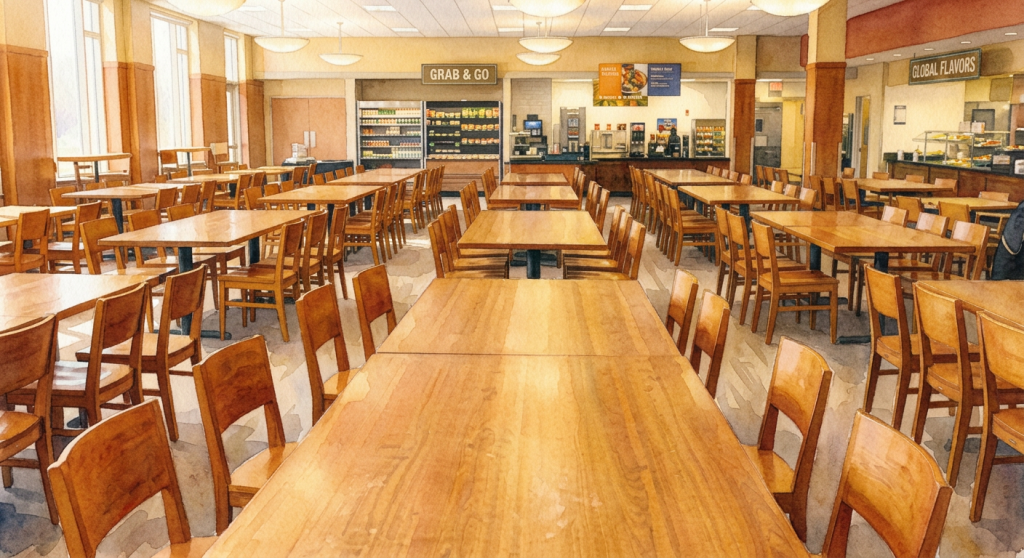
Every day at Westbridge High, the cafeteria looked the same. Not because of the food, but because of the seating. Everyone had their “assigned” seats. Not officially assigned, but everyone knew exactly where they were supposed to sit.
There was the table of the Latinos who laughed loudly and spoke Spanish. Another table was the Asians who were known for being in honors classes. The athletes sat in the middle where everyone could see them. The theater students stayed near the stage doors, always talking about rehearsals. Other students had their own corners too. The rule was never created by anyone, but everyone followed it very strictly without questioning it.
Sara noticed it on her very first day.
She had transferred to Westbridge High at the beginning of her junior year. Her family had moved across town because her dad had accepted a better job offer. Her mother constantly kept telling her this move was a chance for a fresh start. Standing in the cafeteria with a tray of pizza and fruit, Sara did not feel like it was a fresh start at all. She felt like a stranger in a room full of people who already knew where they belonged.
Sara was Pakistani American. At home, her family spoke Urdu and English. Her mother cooked biryani one night and pasta the next. At weddings and Eid celebrations, Sara wore colorful traditional clothes with gold embroidery. At school, she wore hoodies, sneakers, and jeans like everyone else. She belonged to many worlds, but at school, it felt like she belonged nowhere.
She looked toward the South Asian table because it seemed like the easiest place to begin. A few girls were laughing and talking quickly. Sara walked over carefully.
“May I join you?” she said.
One girl shrugged. “Of course.”
Sara sat down and tried to smile. They started chatting about some family friend whom she didn’t know anything about. One girl turned around after a few moments.
“Do you understand Urdu?” she asked.
“A bit,” Sara said.
The girl nodded. “Ah.”
And then they carried on with their conversation.
Nobody was rude, but nobody spoke to her either.
For the next couple of days, Sara ate lunch alone near the vending machines.
Two weeks later, her world history teacher, Mrs. Alvarez, announced a new project.
“For the next three weeks,” she said, writing on the board, “you will work in groups on the Multicultural Showcase. Your project must explore identity, culture, and community.”
Several students groaned.
Mrs. Alvarez smiled. “And no, you can’t choose your own groups.”
She handed out slips of paper to everyone. Sara looked down at hers.
Group Seven: Sara, Elijah, Liam, Emma.
Sara didn’t know these people at all. She just knew them by connecting their names to faces but had never interacted with them. It was always hard for her to initiate conversations first in general, so being in a group with people she had never interacted with didn’t help her shyness.
Elijah was smart and quiet. He watched what he said and only spoke when he needed to, but he had friends like him too. He and his friends were always involved in school events and helped out with student council.
Liam carried himself well. He was a bit on the louder and more obnoxious side, but still did what he needed to do and got decent grades.
Emma was not the kindest, let’s just say that. She was one of the few girls in the school that everyone knew about. She was very confident, bossy, and a little stubborn.
Sara already knew it would be difficult.
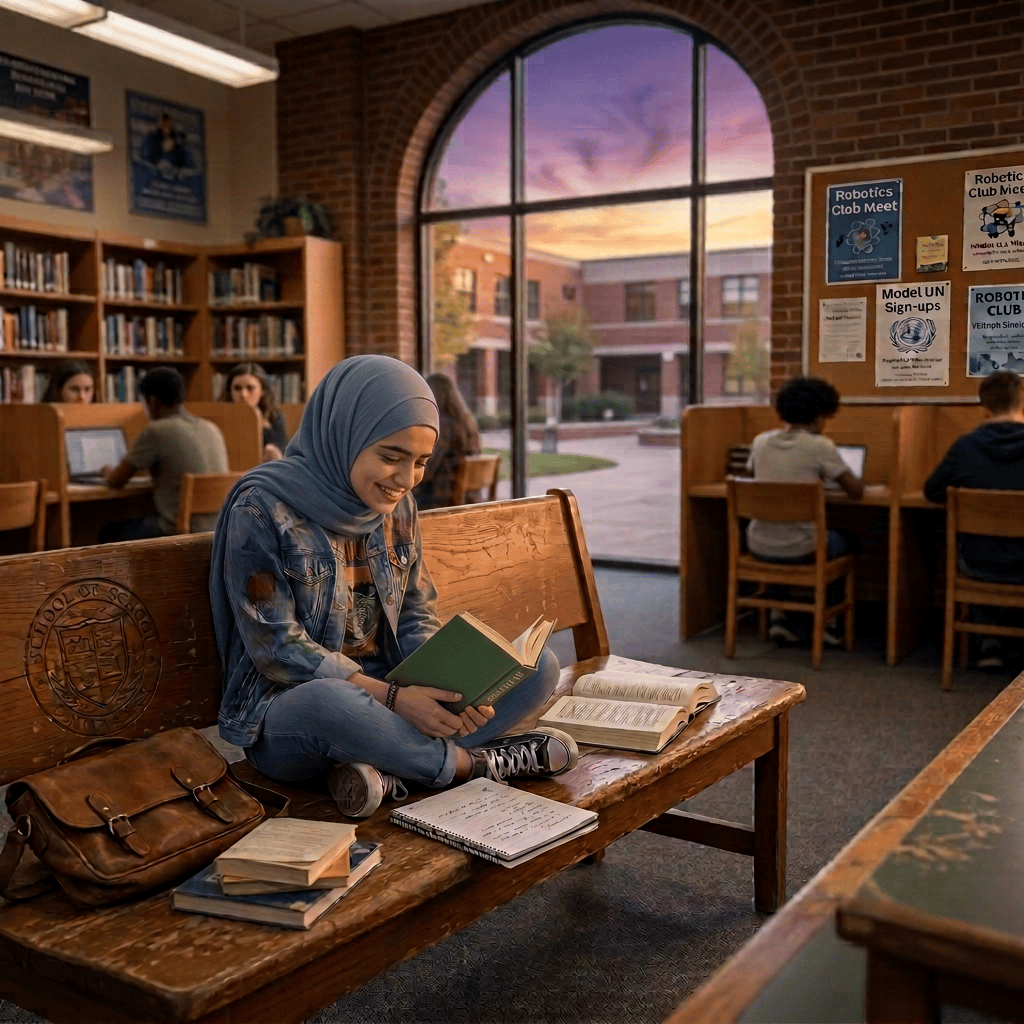
Their first meeting took place after school in the library.
Emma opened her laptop immediately. “Okay, we need a plan. Each person can present their culture. Easy.”
Liam laughed and said, “Did anyone bring snacks?”
“That is not serious,” Elijah replied.
Elijah looked at the assignment sheet. “We need a powerful message that actually makes an impact when we present.”
Then Emma turned to Sara.
“Do you know what you want to include for your culture?”
Sara hesitated. “I’m not sure. There are a lot of things.”
Liam laughed. “Great start.”
Sara went quiet.
Over the next week, the group only became worse.
Liam joked whenever things got serious. Elijah corrected everyone’s facts and sounded annoyed most of the time. Emma tried to control every detail. Sara stayed silent because every time she tried to speak, someone interrupted.
One afternoon, Liam said, “People probably expect me to show up with tacos or something.”
Emma laughed sarcastically. “We are not doing that.”
Liam’s smile disappeared. “That’s not the point.”
The room went silent.
Sara noticed something at that moment. Everyone in the group was frustrated for the same reason. They were all being seen as stereotypes instead of real people. People liked to assume things about others without even learning about them or their cultures.
Everyone noticed the tension but no one spoke up.
As the deadline got closer, the tension grew. They met during lunch one Friday to finish planning. They sat at an empty table in the middle of the cafeteria while the same groups surrounded them.
Nearby, Sara overheard two students talking.
“This project is pointless,” one said.
“Yeah,” the other replied. “People should just stay with their own groups anyway.”
They laughed.
Sara looked around the cafeteria. The athletes sat at one table. Honors students sat at another. Students were divided by race, clubs, popularity, and language. A school full of diversity, yet separated by invisible walls. She noticed the problem and came to a realization.
“Maybe that’s the problem,” she said.
She turned toward her group.
This was the first time Sara was properly talking to them. Her voice was shaky, but slowly she became more comfortable.
“Everyone already stays with their own groups. Look around. We act like this school is united because there are different cultures here, but most people never cross these tables.”
No one interrupted her.
“At home,” she continued, “some relatives say I’m too American. At school, people think I’m not cultural enough because I don’t speak perfect Urdu. Some people ask me where I’m really from, like I don’t belong here.”
She took a long breath.
“I’m tired of feeling like I have to prove myself to everyone. This tension is so irritating, trying to be a different person for everyone just so they don’t judge.”
The cafeteria noise seemed far away.
Liam added, “I get that. People think I’m just a funny guy. If I act serious, they get uncomfortable.”
Elijah adjusted his glasses. “Everyone expects me to be perfect. If I fail one test, it will be shocking.”
Emma looked embarrassed. “I thought I was helping by taking charge. But maybe I never listened.”
For the first time, they were honest with each other.
Sara spoke again. “Maybe that should be our project.”
“What?” Elijah asked.
“The difference between diversity and connection,” Sara said. “Having different people in one building does not mean they understand each other.”
Liam smiled. “Exactly.”
Emma closed her laptop. “Then let’s start over.”
From that day on, the group changed completely.
They shared stories instead of assumptions. Liam talked about translating for his parents when he was younger. Elijah described the pressure of always being expected to succeed. Emma explained that people assumed she had no culture at all because she was white, even though her family kept traditions from Ireland and Germany. Sara talked about balancing two identities and feeling judged by both sides.
They realized culture was more than food and flags.
It was family expectations, language, memories, values, music, holidays, and pride. There was also confusion, pressure, and belonging.
Together they created a performance instead of a slideshow.
They began with four desks separated across the stage, each student sitting alone. One by one, they stood and spoke lines about the labels placed on them.
They performed one by one and each shared their own story, heritage, culture, and most importantly, identity. They talked about imperfections and how everyone came from different places, and how people should embrace those differences instead of hiding from them.
“They ask me where I belong,” Sara said clearly. “But belonging is not something others give you. It is something people build together.”
The room became silent.
They moved the desks into one circle and stood side by side.
For one long second, nobody reacted.
Then applause began.
It started with a few teachers in the front row, then spread through the room until nearly everyone was clapping.
Sara looked at her group and smiled. For the first time since coming to Westbridge, she felt seen.
The next Monday, she entered the cafeteria expecting everything to be the same.
At first, it was.
Then she noticed small changes.
Two athletes were sitting with theater students. A student from the honors table was laughing with someone from the band. Liam waved her over to a table where Elijah and Emma were already sitting.
There were students from different groups there too.
The invisible walls didn’t disappear completely, but they were slowly changing. People were becoming more inclusive.
Sara sat down.
No one asked her to prove how Pakistani she was. No one asked where she belonged. No one expected her to choose only one side of herself.
For the first time, she realized the project had changed more than a grade.
It had changed people’s perspectives.
Westbridge had always been diverse, but now it was finally starting to become united.
And Sara understood the lesson better than anyone else: differences do not divide people. Refusing to understand them does. She felt she had made a change, and she stood proudly for that, representing not just herself, but her whole community alongside her.





Leave a comment