“15,304
15,305
15,306
15–”
A gruesome scream interrupted his count, forcing him to once again start over. To try to perceive time in any way possible.
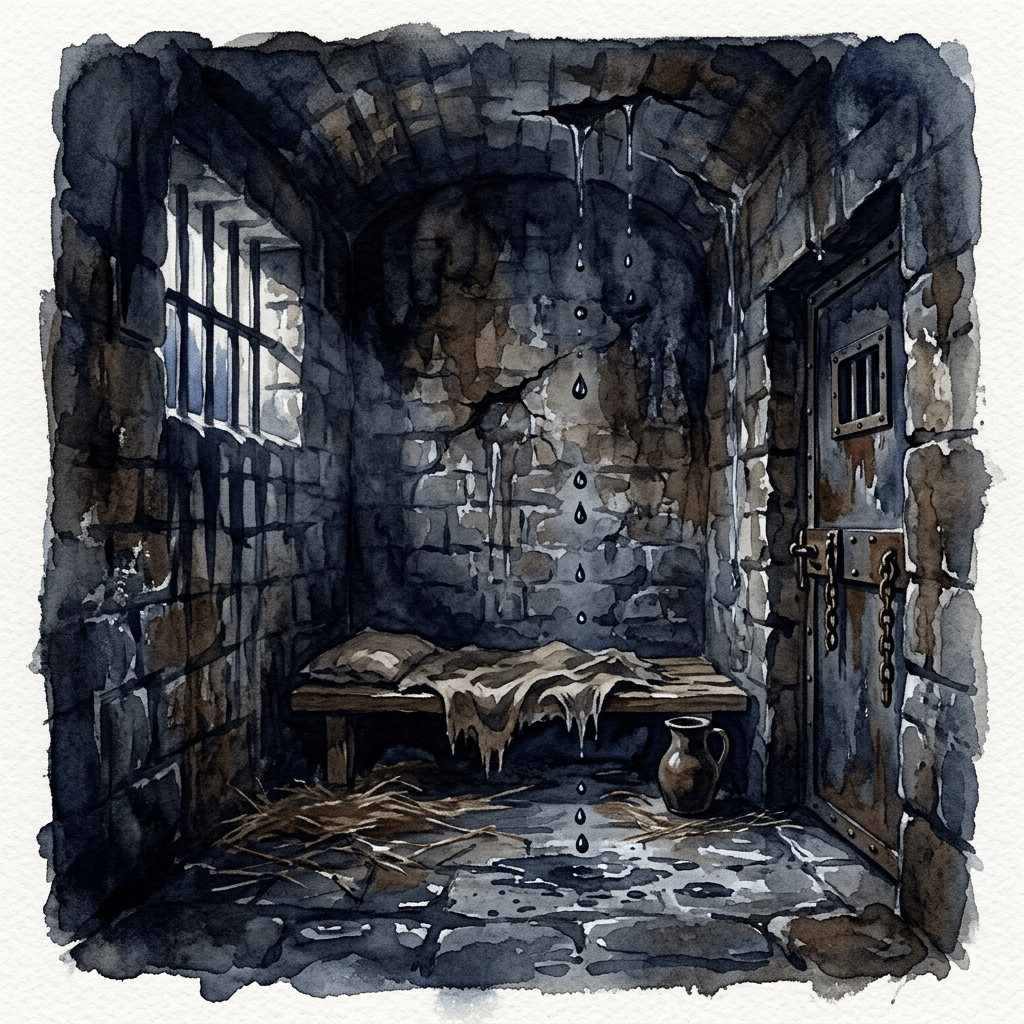
It had been nearly eighteen earth cycles since he was thrown into this cell, with the excruciating heat constantly burning through his skin. When it rained, the dampness in the cell only brought about disease and death. He had already eaten the stale bread they had thrown into his cell, the only indication of a new day within this isolation. Attempting to count the seconds was the only way not to lose touch with reality.
Four steel walls surrounded him, blocking him into a space that reflected half of a standard parking spot. An area too small to live in, but just big enough to rot in.
He had been forced in here after a failed military coup against King Hassan II of Morocco. Sentenced to death without a specific timeframe, the hours stretched on, days blurred, months raged, and years ceased to be relevant. The scorching heat burned through skin, starvation ate away at flesh. He had forgotten what his face looked like, and the only words he remembered were those that described suffering.
“Hey!” a familiar voice yelled.
“Yeah?” he replied.
“I heard some things, quite questionable things,” the voice said.
It was impossible to have human interactions, yet the gaps above the cells that allowed the sun to burn through also allowed prisoners to find solace. They were able to interact through the walls, through broken words and screams of horror.
“What?” the man questioned, his voice shaking just like his thin limbs.
“The public found out about us. They say that we should be free, not suffer because we were loyal soldiers.”
“Really?” the man said, void of emotion, as his head lay against the harsh concrete wall and his eyes wandered in the minimal light. “God knows how long it has been. Even if we were freed, we would have missed society. We would be deemed criminals. We would never ever be free, even outside of this cage.”
“Well, with that attitude definitely not.” The other person sounded annoyed. “Do you know what kept me alive for these short few years? What allowed me to keep touch with my sanity and my old life?”
“What?”
“Hope.”
The man cracked something that he thought resembled a smile. After more than a decade in solitude, things began to fade. The mind was kicked into fight-or-flight, and over long periods of time, the impacts became drastic. Every fiber of the body began to focus on self-preservation, on holding onto every broken piece. Old memories became reasons for life, reminders of what once was. Hope became buried underneath doubt. Hope of freedom, of the end of suffering, hope of a peaceful end. And day after day, as wails danced across the compact walls and voices of insanity sang aloud, hope became an abstract concept, something that easily frayed.
“I lost that long ago.” Memories of his family played in his mind. “Back when I still remembered.” He strained to picture their specific features, but he could only see vague silhouettes, and suddenly his face became slightly wet. He looked up confused and realized the foreign liquid was coming from his eyes. A tear, one he rarely let out because the action yielded consequences. One droplet contained crucial nutrients, ones that he needed to conserve.
He wrapped his arms around his body. His skin was tightly attached to his bones, his ribs the only thing adding width to his frame. His torso had become completely hollowed out. His frame had become so minuscule that he felt he could wrap himself up in a box if he tried to.
“I am glad that you have been by my side,” the voice said. He had a thick rasp to him, one that stayed no matter how bad the dehydration became.
The man was unable to respond. He simply closed his eyes and tried to use the remaining fragments of his mind that still worked well.
When he first got there, less than eighteen years ago, he was sure there was a way out. That his commander would save him. Yet he remained waiting to this day. He had attempted to kill the king, he knew that, which made him even more angry at himself. How could he? How could he throw his life away like it meant nothing? Nothing was ever appreciated until it was lost, something this man realized far too late.
“If we get out, what will you do?”
“Nothing. I will do nothing.”
“What about your family? You said you had one, no?” The stranger kept pushing. “Or have you lied to me the past two years?” He was a new addition to the prison, a young man who had made quite the mistake.
“I had one. A long time ago. But I have nothing now, and I will never have anything ever again.”
“How have you survived here? I have endured but a fraction of what you have, and yet I struggle to remind myself to hold on by the day.” The young man, no, the young boy, spoke with emotion. His throat clogged up from regret and sorrow.
“You get numb. Time does not heal wounds, it makes them more bearable. After the first few years, I learned to adapt to these conditions.” The man looked down at his arms, not that he could see them clearly enough. His thumb traced around his ring finger. Even after nearly two decades, he tried so hard to hold on. “The difference between me and everyone else who is already dead is that I have accepted my fate.”
“Accepted suffering?”
“No, accepted death. And because of that, every day I do not let fear command me. But my acceptance does not just mean I will allow myself to rot without a fight. Rather, it means I will embrace the future that is destined for me. That I will die fighting, trying to conquer this cruel obstacle.”
“Well I cannot accept death because regret forever flows through my veins.”
“Then let yourself bleed out,” the man said, and after that he did not speak.
Time passed, and over the next few days the man no longer heard the young boy. He would call out, yet it seemed the boy had been lost to fate. Sadness gnawed at him due to this realization. He had become reliant on human interaction for the past two years. All the other things that compelled him to hold on had faded.
Today it was raining. Droplets of water aggressively beaded down on him, relentlessly assaulting his broken frame. He finally let true tears flow. They mixed with the rain, and it all felt poetic in his eyes. Even though he had been in this cage for so long, it had become a home for him. As twisted as that seemed, it was the only way to endure the psychological strain of such harsh conditions. Humans adapted to their circumstances, some later than others, but they all eventually did. And yet the young boy, who seemed to have more light than the man, died. The weather had gotten bad, illness struck, and with the lack of medical attention, it became clear that death was on the horizon.
Yet it was still hard to accept. They say that the more you experience something, the more you get used to it. That an individual becomes desensitized, yet this man felt quite the opposite. He felt bile rising in his throat, the same crumbs of food he had eaten consecutively threatening to flow out. The only thing grounding him to reality had faded, perhaps his sanity along with it.
Suddenly he broke the excruciating silence with a hysterical laugh.
“How pathetic,” he said with a soft breath. “I did not even mourn my loved ones this much, and yet I miss a stranger whose face I will never see.”
He looked up, the rain causing him to close his eyes.
“Please, make me sick. Take me away.”
He stood with the last bits of his strength, his knees cracking.
“I have had enough!” he yelled as loudly as he could, his voice awfully rusty. “I am sick of this! SICK!”
He fell to his knees, and his next words came out as a whisper.
“Why? Why is fate so cruel?”
This man had participated in a coup against the King, the most beloved man in the nation. Of course he would suffer the consequences, yet that fact did not mix well with the turmoil in his mind. He could only see what he had lost, not what he had attempted to take.
There were no sharp objects in the room. The food he was given was too thin and small to do any damage with. He had long realized there was no escape. That he could not choose how he went out, but only yearn for it by the day.
He looked around the damp cell. Water collected on the floor. An idea popped into his head. If he got a cruel illness from this liquid, then he would finally be free. So he drank as the sky wept and his own salt mixed into the puddles. He thought of everything he once loved, everything he once desired, everything he once chased. And he realized that he had made a grave mistake. That if he had declined his captain, then he would have died a merciful death.
That if he had known before what would happen, his family would at least have been able to bury a corpse. To finally have closure.
He looked at the water, the slightest reflection of himself peeking through. He looked like a ghost of what once was. He looked away so quickly that he nearly got whiplash, disgusted by his appearance.
“Kid, even if I was free…there would be nothing left for me.”
The man died not long after, finally succumbing to the cruel conditions of his own personal hell.
A day after his demise, Tazmamart was finally shut down. There were only a handful of survivors left, and they dragged the man’s body out as one of the confirmed tragedies. He was light. His eyes were found wide open, his body colored in cruel shades.
If he had held on for just a little while longer, his freedom could have been secured.
Yet that was something he had told himself for the past eighteen years within those four walls. He had tried to kill the king, and he paid with more than blood.
His family received his body. They were advised not to look at it, not to glance at the horrors that had taken place. And they were silenced, not allowed to speak on what occurred within those walls.
One mistake could cause a lifetime of suffering, but inaction could also result in worse. Fate is cruel, but it only reflects an individual’s actions. Tazmamart was a cruel place, as was war, but humanity was even more so.





Leave a comment