
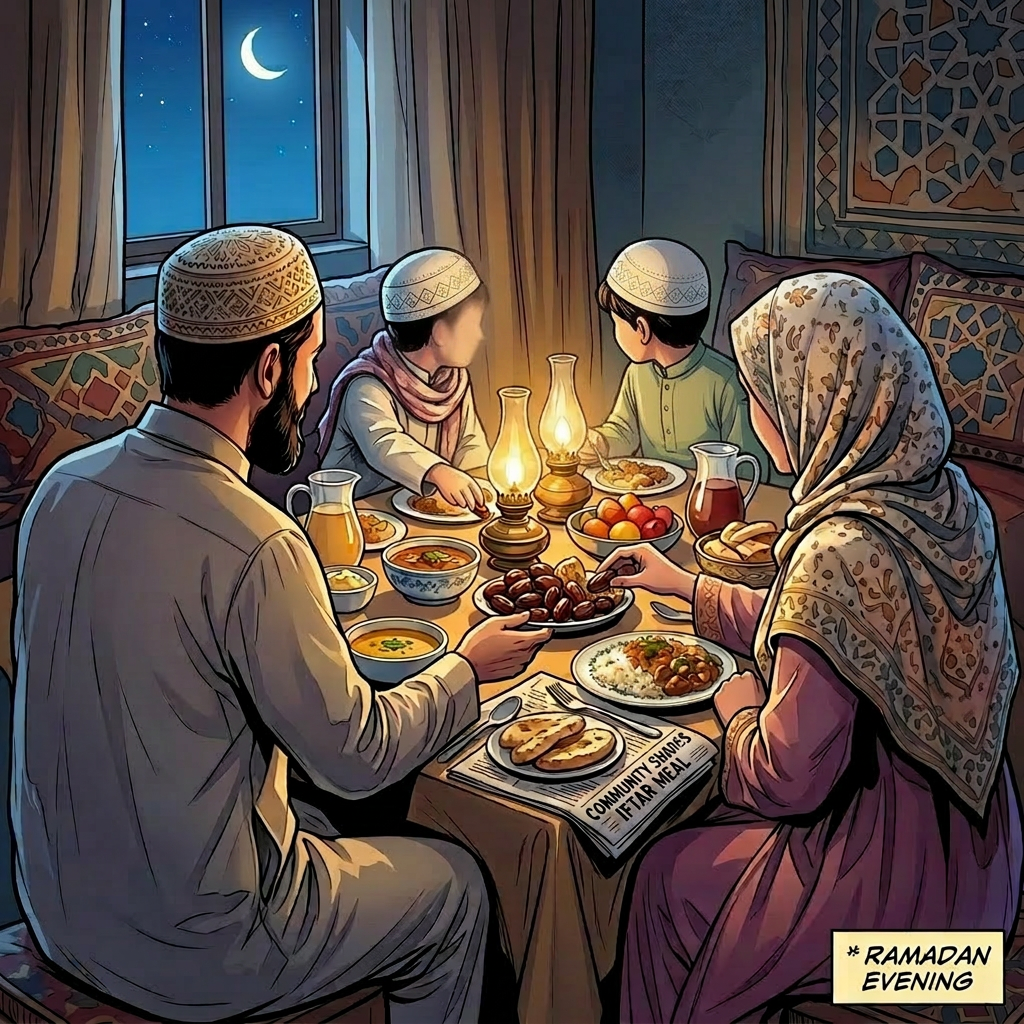
Nasib had always thought of Ramdan of the same holy month that appeared every month with the longing peaceful rhythm. In his house before sunrise, his room was packed with the same sounds of his mother making roti as she pressed the hand made dough with her hands as the smell of warm food rushed into the hallway. Suhoor for Nasib was quite simple, with a couple of parathas, chai, eggs,water, and dates to help the house mood. It was fasting, praying , and patience and sabr in a loop that seemed so quick. He never actually pondered about how Ramadan could look or feel in other homes or communities, countries, or even in part of his own city.
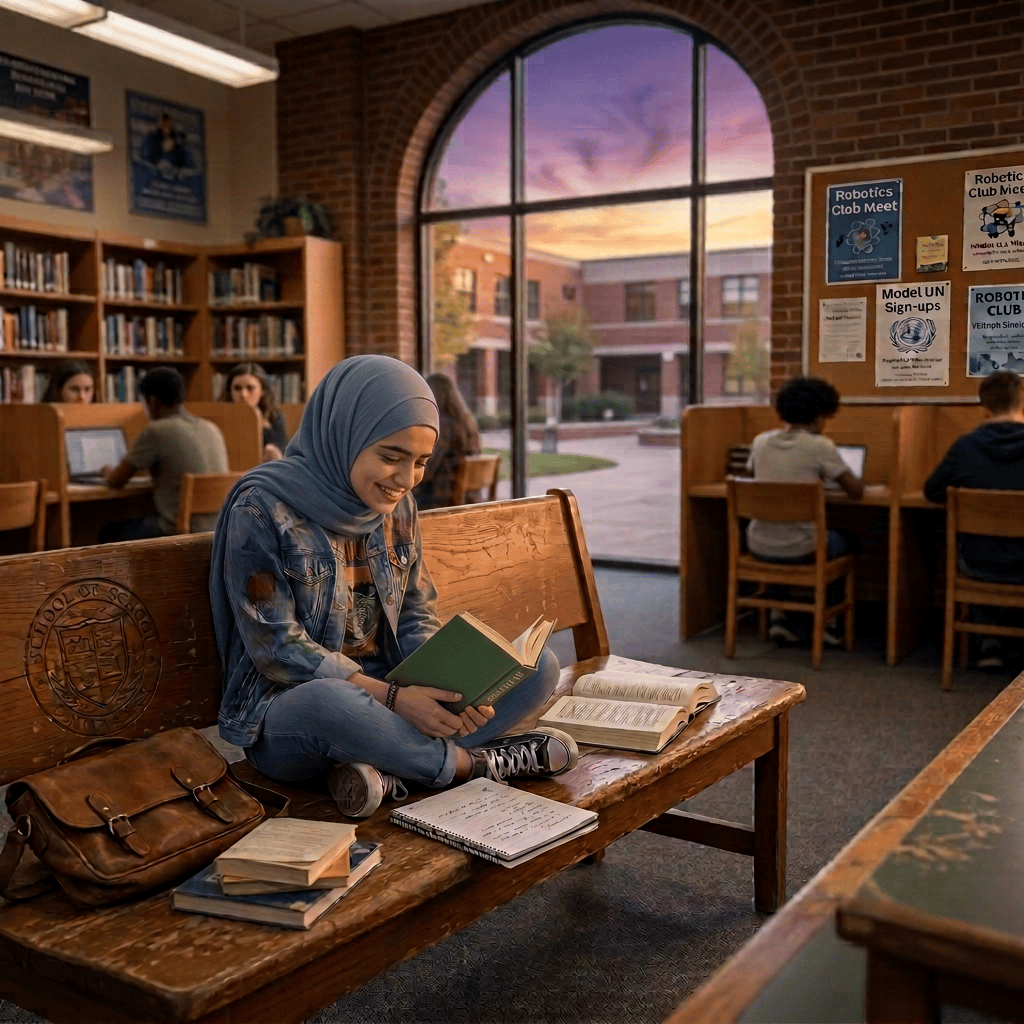
That feeling woke up when he started high school. His new school was much more diverse and different from the one he’d been to before. Students were from diverse backgrounds and were well assimilated into their own cultures and practiced it in their own ways. Some students brought the same lunches that smelled of spices that Nasib did not recognize. Others wore traditional clothes and switched between English and their own cultural language in a way that seemed fit. He heard fragments of Urdu, Arabic, French, and Pashto in the narrow hallways that were almost always crowded to the brim. At first it felt overwhelming. He was used to people sharing similar beliefs and thoughts about Ramadan, or at least understanding what it meant to students. At this moment, he realized many students didn’t even know what Ramadan was.Some students had never seen anyone fast before.He began to realize that Ramadan could look different at times from where people had come from, how their family lived, and how culture is formed at homes and schools.
During Nasib’s first week of Ramadan, Nasib attempted to balance out fasting with schoolwork, sports, and daily activities.He felt more tired than usual, especially in moments during the afternoon when his energy dropped, where his head still felt heavy. Despite this, Nasib knew and acknowledged how fasting is especially meaningful since it teaches students and people about why patience and gratitude is important to go through tough days. It showed that even food and water were not to be taken for granted and rather be appreciated.
One day in the cafeteria, Nasib sat at an empty table near a group of classmates eating lunch. One student has rice and curry packed in a metal container.The other had hummus and pita with a side of olives.Another student had a simple sandwich with some apples.The food itself explained where people came from, as each food has a story behind it.This showed that multiculturalism is not just about how people are different with their own thoughts and beliefs but rather how those differences are shaping the same space in unique ways.
As Ramadan continued, Nasib stayed mostly inside of his room while the rest of the house slowly filled with noise.From the bottom of the hallway, he could hear many different sounds; cabinets opening and closing, his mom moving through the dining area and the low sound of a conversation starting to form. The house starting filling with the smell of food which instantly drifted inside of his room, but it wasn’t an occurrence of which he paid much attention to.His desk was cluttered with papers notebooks and his phone facing side down. Everything seemed out of place even though nothing big had actually happened.
As the slow days passed, Nasib’s view of Ramadan began to widen and open up. The quiet mornings, prayers, and family meals were still important to Nasib but the views of Ramdan started to shift as he noticed it was something that helped him connect to others. He now saw the month as a time where others also carried the traditions around them mindfully.Some traditions were loud and colourful, while others were private such as Nasibs.Something common in all of them is that they all shaped a meaningful and central identity. It meant that living in a multicultural society is where students have to learn about other stories and respect it.
As the days moved closer to the end of Ramadan, Nasib started noticing small yet tiny changes in the way students acted around him and other classmates. At school, a different kind of energy formed, as if everyone was slowly becoming aware that something was about to end. Some students who were not fasting came to recognize that this sacred month held importance for other students around them. These moments of realization helped shape the moments about why respecting everyone’s culture is important and crucial.
In class, Nasib found it quite hard for some days to stay fully focused because his body felt the weight of the routine he had been continuously following. Even when Nasib felt tired, there was a sense of discipline that carried him throughout the day. He started realizing that fasting is not just about food and water, but also about learning patience and discipline in times like these.
One evening, after iftar, Nasib sat quietly inside his room. He could hear the soft movement reflecting of his family, small and quick sounds from the kitchen,and the noise of the house tv alive and speaking. His desk was almost unchanged; messy papers scattered along his small desk as he had stopped caring about during the month. His phone was face down as before, making it seem unimportant at the time. But now, his thoughts were not as scattered and started to align properly.Now, there was a sense of reflection that had slowly been building throughout Ramadan.
He thought about school, the whole experience as a whole, about the cafeteria tables, about the conversations he had overheard, as well as the ones he’d been part of. He now pondered about how different people experienced the same month in completely different ways,quiet or loud, yet similar and steadfast in the same patience and perseverance needed to get through the month. It made him realize that Ramadan was not just a matter of personal beliefs, but also something that is split across communities, even if it differed comparatively from person to person.
As the final and last week of Ramadan neared,the school environment became much more relaxed to Nasib. Although teachers were still teaching and assignments were still due, there was an awareness that the monthly routine was finally coming to an end. Various students talked openly about Eid plans, while others simply looked forward to the break that was upcoming in school.Nasib noticed how even the hallways felt slightly different,much less tense, more vibrant and open, showing Nasib he wasn’t the only one with a changing mindset.
At home, Nasib’s mom began to make decorations around the house as Eid was near. His dad and mom were planning visits to meet family overseas during the break on Eid as it was an occasion that only came once a year. Nasib would mostly sit in the living room and listen without saying much, just observing how his house was changing in the smallest detail in preparing for the eventful day tomorrow as it neared.
The night before Eid felt much different from all the nights previously during Ramdan. The house was lacking sound,a quiet anticipation from Nasib as he looked forward to changing into his favorite clothes the next morning. He lay in his bed, staring at the ceiling for a long time staying concentrated as he thought without moving. His room definitely held the same feeling as before, but his mind did not. He tried to summarize the entire month from beginning to end as it occured. Nasib often found himself replaying the time before the month and compared it to now as his whole mindset shifted as he now valued these quiet and peaceful nights more than ever.
Outside of Nasib’s room, not everything was crystal quiet. His family was still awake, preparing the next day as it came,whilst speaking in low voices, and moving through the house with purpose. The sounds of movement were not distracting, but rather grounding. This new feeling of self-accomplishment as he’d drifted past the month stayed in Nasib’s mind as a trophy, as if every moment built up in Ramadan was for this feeling right now.
Slowly, the house began to quit as if time was being tampered with. The movement outside his room started to fade, the voices now gone, and the sense of activity moved back into the silence that filled his mind. Nasib lay on his bed still and upright, and shifted onto the right side of his room for a more comfortable view of the night through his window. The anticipation of Eid was increasing as he slowly threw the thoughts out the window and lay back into his original position.
Nasib finally came to close his eyes, allowing himself to rest. The thoughts of the month, the daily routines, and the morning prayers helped form the anticipation of a new day filled with celebration for the hard earned month. As the house was calm and quiet, Nasib grasped the last night of Ramadan promptly, before the arrival of Eid.




Leave a comment