
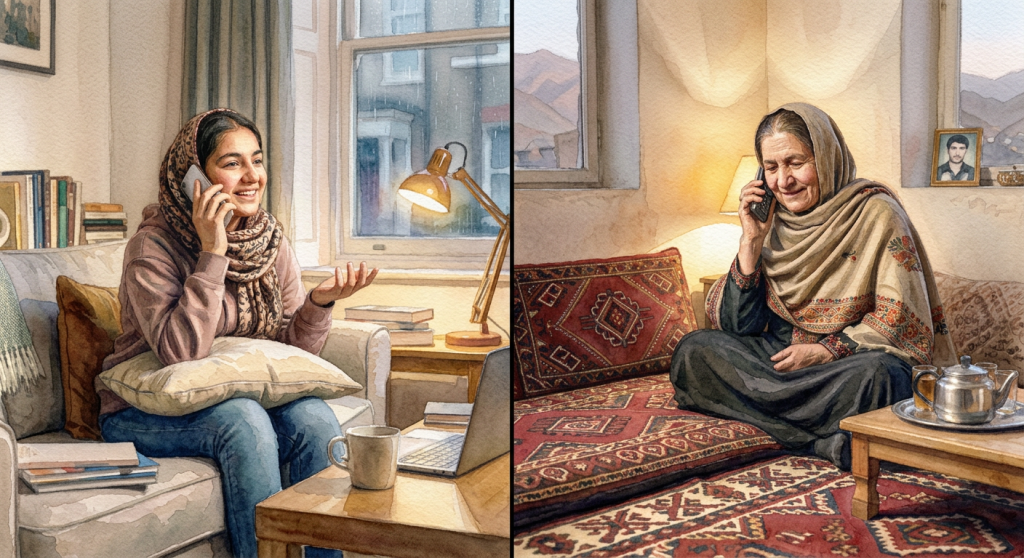
The last time Hasina spoke Dari without thinking was when she was five years old. She doesn’t remember this, she knows this based on the stories her family would say about her when she was younger. Her mother once told her,
“You used to speak so fluently,” her mother said. “Always with your grandma, confidently, you didn’t care who heard.”
That girl was gone.
At fourteen, Hasina sat at the table of her cousin’s living room, surrounded by aunts, cousins, and close friends she saw once in a while. Everyone was laughing, as someone told a joke. Hasina understood it. She understood everything. The joke was a play on words, which foreigners wouldn’t understand even if they were fluent in Dari. Her brain translated it, instantly, the way an eye blinks when bright light flashes. But when her aunt turned to her and said,
“Hasina, what do you think?” in Dari, Hasina’s mouth froze. I think it’s funny, she thought in Dari. The words were in her mind, perfectly formed, perfect grammar, correct pronunciation. In her head, she was fluent.
“I think it’s funny.” she said in English. Her aunt made a face, just for a second. Then she turned back to the adults and Hasina became invisible again.
This was the cycle; understanding everything yet speaking nothing. Watching other afghan girls her age born in america just like her, swap between Dari and English without hesitation. Girls whose parents had kept the language alive. She knew her parents had good intentions.
“We wanted you to fit in.” her mother would tell her. “We didn’t want you to have an accent or difficulty communicating.” so that meant english at home, at dinner, english until Dari had become a foreign language to her. By the time Hasina was old enough to be angry about it, the damage was done.
The first time she truly felt humiliated was at an Afghan grocery market. She was thirteen. Her mother needed fresh bread. She was speaking to her mom in English, then, an elderly woman spotted her and asked,
“Are you Afghan?” in Dari. Hasina understood, of course she did.
“Yes.” Hasina said in English. The women smiled and said,
“Then why dont u speak Dari with your mother?” she asked in Dari.
Hasina froze. The answer was in her head, because they never taught me, because they thought english was more important, because i was a child and children don’t have a say. But the words couldn’t escape from her mouth. She stood there, mouth half open, then her mother answered for her,
“She speaks English at home.” she replied to the women in Dari.
The woman’s smile turned pitying. That smile stayed in her head for a year and ongoing.
Her grandmother was worse. She wasn’t mean, never mean. But every conversation was a small death. Even if it was simple words, she would stumble. She would mix English and Dari into something that wasn’t a language at all. Her grandma would wait, smiling at her. Hasina would look at her mother. Her mother would translate. And later in the car, Hasina already knew what her mother would say.
“Why don’t you know it? You heard it your whole life. It’s an embarrassment.” her mother said.
“You always speak English,” Hasina snapped. “Its not my fault.”
Her mother went quiet.
At school, she met Zara. She was Afghan too, same grade, American born as well. But Zara spoke Dari like she’d never left Afghanistan, quick and sharp and full of jokes that only afghans would understand. Zara’s parents had done it differently. Dari at home. A grandmother who lived with them and refused to learn English.
“Just practice,” Zara said when Hasina told her about her struggles. “If you think it, you know it,” Zara said.
Which was easy for Zara to say, her language had never gone ghost. But then Hasina started trying. She found youtube videos, afghan music, news channels, cooking videos. She listened to old songs her grandmother and family used to listen to, pulling up lyrics on her phone, lipsyncing the words alone in her room to get the flow and hang of the words she couldn’t pronounce. She said it over and over until the words stopped feeling foreign. She then found an online class. She used her own savings to pay for it. But the teacher spoke a different dialect, more Iranian farsi than Afghan Dari, the words felt completely unfamiliar. She quit after three classes. She found another, and it had the same problem. Why is this so hard? She thought.
In her head, she could hold entire conversations in Dari. She could argue with her mother, apologize to her grandmother, order food and request items at the local grocery store. Her inner thoughts were fluent, she hadn’t forgotten a single word. Her thoughts lived behind a wall that her mouth left.
The anger became unbearable. Towards her parents, and towards herself. At the aunts who whispered pitifully or judgingly. The cousins who translated for her as if she couldn’t speak for herself. At zara sometimes, often brought up from jealousy, for knowing it entirely. One night, her mom handed her the phone to speak to her grandmother and Hasina only spoke three words before freezing and muting the call, frustrated with her mom.
“I don’t know what to say to her. Why do you always do this?” she said to her mom. Her mom looked at her disappointed and walked away.
After that night, something changed. The anger didn’t disappear, it just became useful. Hasina stopped waiting for someone to teach her the right way and started teaching herself. She found a podcast by a group of afghan americans, some fluent and the rest relearning. They talked about the exact feeling she couldn’t name. Receptive bilingualism. understanding everything, speaking nothing. The host who was relearning said,
“Your brain has the map. You just forgot how to drive.”
Hasina listened to every episode twice. She started narrating her own life. I am studying. I have school. I am cleaning. Always in Dari. Half of it was wrong, but she was trying. She wrote words on sticky notes and put them on her mirror. She pointed at items which were the meaning of the word, even though she already knew them, the point wasn’t learning, it was speaking. She started picking up more phrases at family gatherings. Not speaking, but listening and remembering harder. She already knew the words, but repeated them to make them seem more normal.
After three months she started speaking with her mother.
“Where are we going today?” she said in Dari. The words came slowly. Carefully. Her mother turned around and stared at her. Not speaking. She felt her face burning up, thinking she said it wrong.
“What?” she said nervously. Her mom slightly smiling at her,
“Where did you learn this? You speak Dari now?” she said.
“Im still bad at it.” Hasina said.
“You’re still trying.” her mom said as she shook her head. “It’s a start.”
Hasina is not fluent yet. She still freezes at family gatherings. She answers in English without meaning to. The aunts still whisper sometimes, and the frustration still lives in her chest, quieter now but not gone. But something changed. Last week, she listened to an afghan news channel that was left on the TV, the same one they played every morning, which she now understood every word without trying, even able to read the headlines that were written in Dari. The reporter speaking fast, which she used to get confused about, now brings a sense of relief in her heart, being able to understand each word spoken. She practices with her mom as well. Small things, like asking if the food is good. Her mom smiles each time, even when her pronunciation is off. In her head, Hasina has always been fluent. Now, slowly, her mouth is learning what her heart already knew.
She still cant tell a joke in Dari, thats the real test. Anyone can ask where the bathroom is in Dari. But timing? Inside jokes? The fluency of jokes that make older afghans break into laughter? No way. Last family gathering, her uncle said something funny, something about a donkey and a neighbor, everyone bursted into laughter. Hasina understood everything, she even laughed for a second. The same aunt as last time noticed,
“Its funny isnt it?” she said in Dari.
hasina agreed, her aunt smiled at her.
She continues to speak with her mother, and slowly starts to speak with her grandmother as time goes by. The calls get longer each time, more often aswell. She speaks in Dari as much as she can, introducing herself, asking how her grandma is. The conversations often last until they run out of words and her grandma says,
“Okay, give the phone to your mother now.”
she handed it over. Her mother took it, looked at her, and didnt say anything. Not “good job” or “why can’t you say more.” Just took the phone and started talking.
That was better. Shes not fluent. She’ll probably never be fluent. But shes stopped waiting to be.





Leave a comment