
Irum Sarfaraz is a freelance writer. She teaches ELA and ELC to high school students and often defends through her writing the rules enforced by schools for the greater good of the student community.
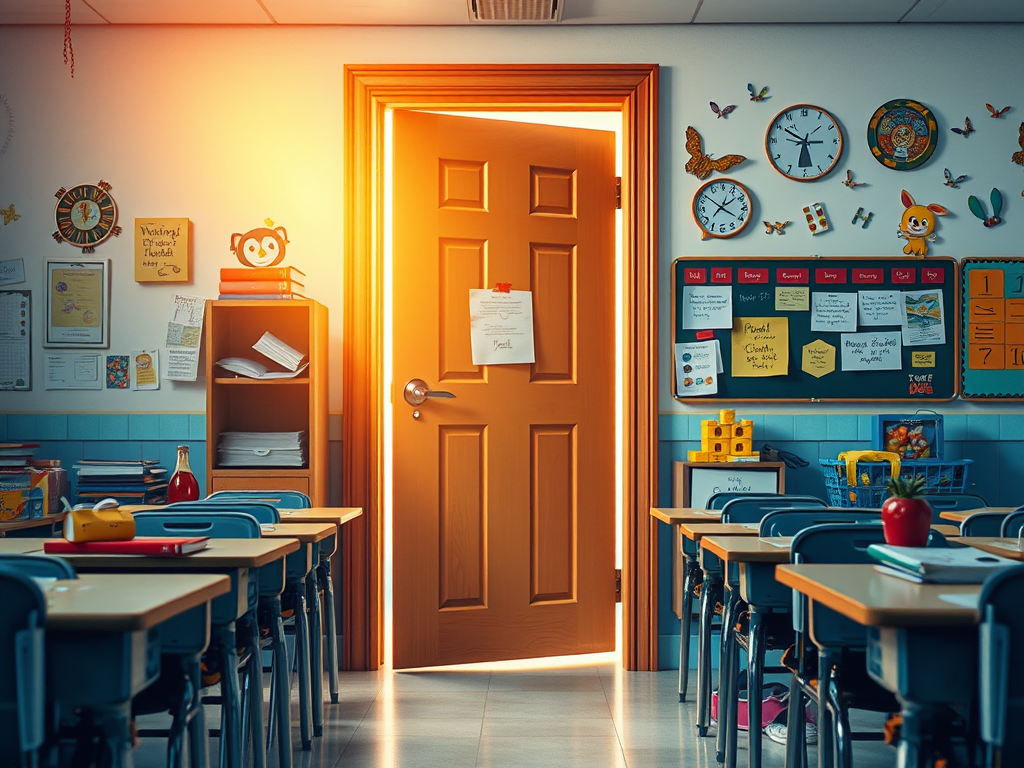
Keeping the classroom door closed when the teacher is not present is probably at the top of the list of countless things that motivates students to actually come to school, because let’s be honest here, they really would be anywhere in the world than school, even if it means being stranded on a deserted island with no wi-fi, no food, and no bathroom.
It is not just my firm belief but an observed fact that when the controversial class door is closed, the classroom becomes a safe haven for students whereby giving them free reign, innumerable rights, and a license to jump on desks, hang from ceilings, break the walls, use foul language, and freely throw around words that cannot even be officially considered any language at all. I suspect I have even heard them meow, bark, neigh, and tweet in closed rooms.
Why and who in their sane mind would even consider meowing, barking, tweeting, and neighing an official language is beyond my comprehension, but obviously, everything becomes sane in a closed room. Hence, in order to maintain the designated borders of human sanity, as outlined by psychologists and psychiatrists, classroom doors must be kept open in the non-presence of a degreed adult.
As expected, this rule comes with immense pushback, and of course it would. This contentious and highly disputed rule takes away the only, and rare, opportunity students have, to not behave rationally, logically, and sanely, as they are expected to behave. Whatever the teachers accomplish drilling into their minds in terms of behavior, knowledge, conduct, demeanor, attitude, disposition, and temperament is instantly vaporized in a room that has no adult presence. The resulting grand pieces of humanity, as witnessed by anyone walking into that closed room accidently, are misbehaved, unknowledgeable, misconducted, and ill of demeanor, attitude, disposition, and temperament. Parents are certainly not sending pieces of their heart and soul to school for 8 hours for them to turn into Mary Shelley’s Frankensteins rather than Rowlings’s Albus Dumbledores. Hence, classroom doors must be left open.
Even though open doors come with outstanding advantages and glaring disadvantages, the fun that closed doors offer to students makes it a near impossible rule to enforce. Students have been taking out rallies, demonstrations, and long marches to protest against it. A group was also found on hunger strikes but it took only a bag of Takis to get them back on track. They dissolved the hunger strike and pretended like it never happened. I guess the power of Takis cannot be minimized. I have gotten wind of a highly aggressive student union being secretly planned also for no greater reason than resisting closed doors. Go figure.
Nonetheless, despite all forms of resistance from the student community, the strength and good intentions of the teaching profession prevails, as always, as creative punishments are enforced and followed through, much to the chagrin of incensed, irate, indignant, and resentful students. They wage wars of words to express their resentment for closed doors but teachers wage their own battles of wisdom to get them to see the light that comes in through open doors and which is shut off when doors are closed.
There are deep lessons in the whole psychology of closed doors and teachers continue their efforts in introducing student communities around the world to this wisdom.




 Student Spectrums
Leave a reply to Madiha Nawed Cancel reply