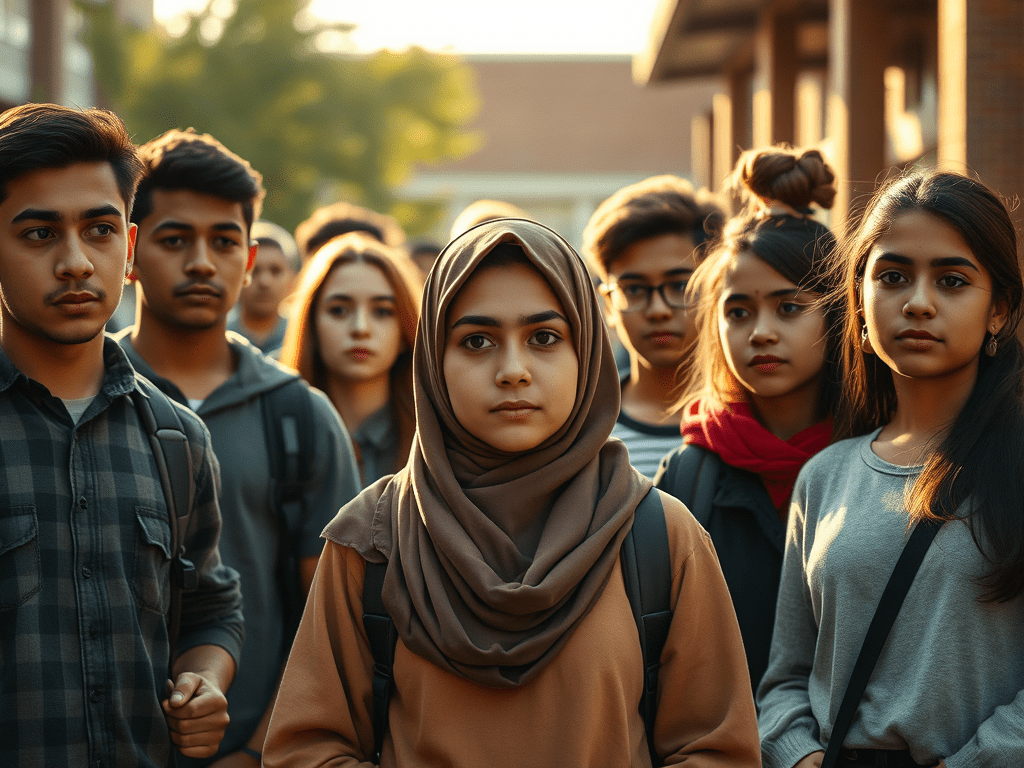
Manahel Rafi is a 15-year-old 10th grader at Ilm Academy who actively promotes understanding and tolerance as a Muslim student. She is dedicated to using her voice to stand up against discrimination in all its forms.
As a high school student in America, I am deeply aware of the tragic reality of school shootings. These incidents affect all students, regardless of their background or beliefs, leaving everyone wondering if their school could be next. But for me, as someone who identifies as Muslim, the fear and concern go beyond the possibility of just violence. There is an additional layer of anxiety tied to my identity and how society sometimes views ‘people like me’.
While I attend a private school that emphasizes respect and understanding, the fear of being targeted or misunderstood is still present. I hear stories of mosques being attacked and hate crimes against Muslims, and it makes me think: Could someone see me as a target because of who I am?
Recently, in September, a shooting at Apalachee High School in Georgia resulted in the deaths of two students and two teachers, leaving several others injured. The shooter, a 14-year-old student, was arrested, but the emotional and psychological damage left behind is immeasurable. Events like these are heartbreaking, and they make many students, including myself, feel less safe in a place that should be designed for learning, not fear. As a Muslim student attending a private Islamic school, I am constantly reminded that my concerns aren’t just about random violence; they are also about being potentially singled out because of my religion.
School shootings have become far too common in the U.S., turning what should be a safe space for learning into a potential target for violence. While the root causes of these attacks vary—hatred, mental health struggles, or easy access to firearms—they share one tragic outcome: lives lost and communities shattered. These shootings impact all students, but for those of us who are visibly different—because of our ethnicity, religion, or identity—the threat of being targeted adds another layer of fear.
A 2020 Pew Research Center survey highlighted that 57% of teens worry about a shooting happening at their school. This already widespread fear can be amplified for students who feel they stand out in ways that might make them more vulnerable. For Muslim students, this fear is often linked to Islamophobia.
Islamophobia, or prejudice against Muslims, is unfortunately still a problem in many parts of the world, including here in the U.S. After major events like 9/11 or other incidents involving extremists who claim to represent Islam, Muslims have often been viewed differently, or with suspicion. According to the Institute for Social Policy and Understanding (ISPU), every year since 2016, over 60% of American Muslims have reported experiencing at least one instance of religious discrimination—higher than all other religious groups in the U.S.
All students should feel safe at school. Regardless of religion, ethnicity, or background, we all deserve to learn without fear. School shootings are an American tragedy, and while they affect everyone, they can be even more terrifying for those of us who feel “othered” or discriminated against. I hope that as we work on addressing gun violence, we also focus on fostering understanding and inclusion within our schools. No one should feel that their identity makes them a target. We need to work towards a society where school is a place of safety and acceptance for all students.




 Student Spectrums
Leave a reply to Student Spectrums Cancel reply